
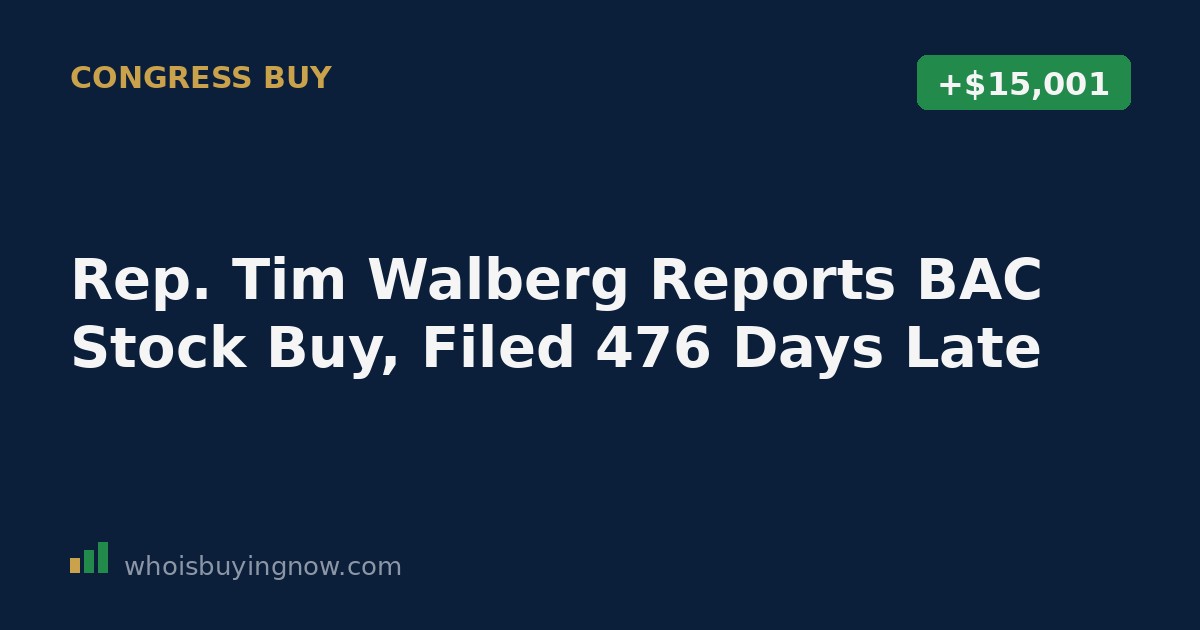
A newly filed disclosure shows Hon. Tim Walberg, a member of the U.S. House of Representatives, reported a purchase of Bank of America Corporation common stock (BAC) in a periodic transaction report submitted under the STOCK Act. The transaction was made through an account held jointly with his spouse, and the disclosed value falls between $15,001 and $50,000.
According to the filing, the purchase itself took place on February 7, 2025. The report reflecting that trade was not filed until roughly 476 days after the transaction date, well beyond the 45-day reporting window required under the STOCK Act. The filing does not include, and this report does not speculate on, any explanation for the delay.
What the Filing Shows
The STOCK Act requires members of Congress and certain staff to publicly disclose trades in stocks, bonds, and other covered securities within 45 days of being notified of the transaction, so the public and watchdog groups can track potential conflicts of interest between lawmakers’ personal financial holdings and their legislative duties. Reports are typically filed using broad dollar ranges rather than exact figures, which is the case here: the transaction is listed only as falling between $15,001 and $50,000.
In this instance, the disclosed transaction is classified in our tracking system as a ‘congress buy’ signal, meaning it represents an acquisition of shares rather than a sale. The asset involved, Bank of America Corporation, is a large, publicly traded financial institution, and the joint nature of the account means the trade could have been initiated by either Rep. Walberg or his spouse, or both.
Why the Timing Matters
Late filings under the STOCK Act are not unusual and are documented across both parties in Congress. The law does not itself specify a penalty structure beyond potential fines for late disclosures, and a delayed filing is not, on its own, an indication of wrongdoing. It is, however, a departure from the disclosure timeline the law establishes, and tracking sites like this one note such delays because they affect how quickly the public can see a lawmaker’s financial activity relative to when it actually occurred.
Readers interested in following this disclosure further can consult the original periodic transaction report filed with the U.S. House of Representatives for the complete record, including any additional details not summarized here. This article is based solely on the information contained in that public filing and is intended as factual reporting on a disclosure event, not as commentary on the merits of the transaction or any recommendation regarding BAC or any other security.